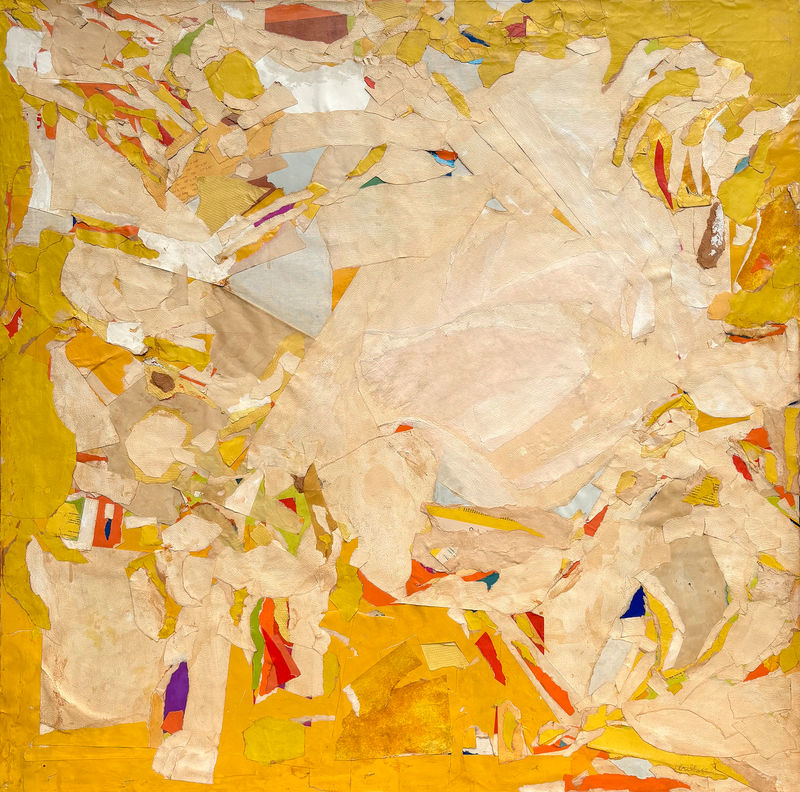
"One artist called Grillo the 'Renoir of Abstract Expressionism', another compared him to Rubens for his sensuality. One critic brought up Turner, while another waxed eloquently about Venetian luminosity in his regard. All of these references still seem apt when you see these gorgeous, light-filled canvases." - April Kingsley
John Grillo was a pivotal figure in postwar American abstraction, celebrated for his exuberant color and unrestrained painterly energy. Born in Lawrence, Massachusetts, in 1917, he studied at the Hartford School of Fine Arts before serving in the U.S. Navy during World War II, where his work began shifting from figuration toward abstraction.
After the war, Grillo enrolled at the San Francisco School of Fine Arts under the G.I. Bill and quickly became recognized as one of the first true action painters on the West Coast. His improvisational methods and experimental materials laid the groundwork for a generation of abstract painters in California.
In 1948, he moved to New York to study with Hans Hofmann, whose theories of color and spatial tension profoundly shaped his practice. By the early 1960s, Grillo’s work had evolved into large, radiant canvases dominated by yellow and gold. Critics compared their luminosity to Turner and Renoir, while Dore Ashton described his paintings as “an attempt to render the impossible.”
Throughout his long career, Grillo explored painting, collage, sculpture, and printmaking, maintaining a lifelong fascination with rhythm, light, and chromatic harmony. His works are represented in major collections including the Guggenheim Museum, the Whitney Museum of American Art, and the Metropolitan Museum of Art.